Published 28 October 2026
Sydney’s Residential Market Softens, but Fundamentals Hold Firm
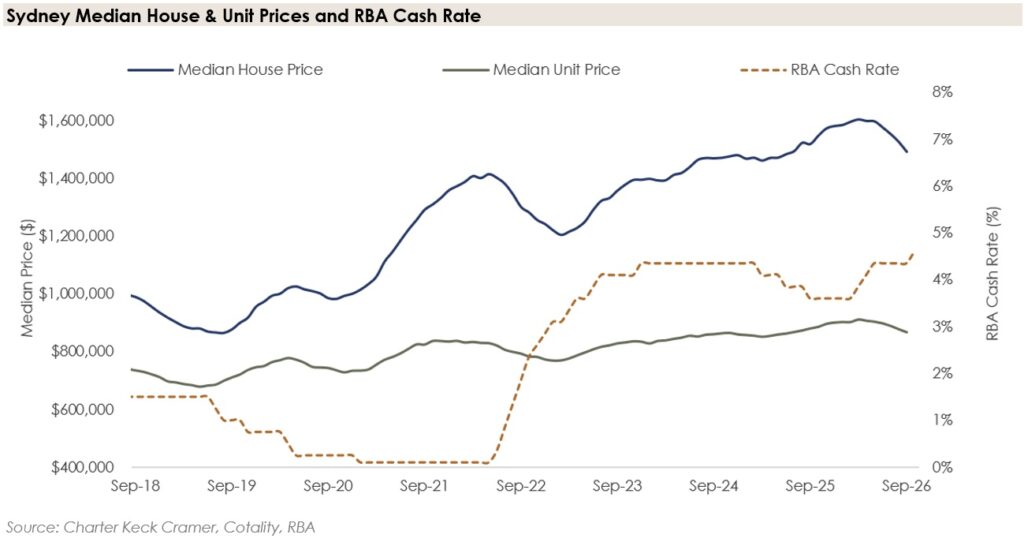
Sydney’s housing market is in a downturn, but its long-term fundamentals remain intact. The median house price fell to $1.47m in the three months to September 2026, 8.8% below its February peak. The median unit price of $868k is 4.8% below its March peak. The decline is being driven by a fifteen-year-high cash rate of 4.6%, stretched affordability and buyer caution following the Federal Budget’s negative gearing and capital gains tax changes. Sales volumes are down 53% year-on-year and clearance rates have fallen to the low 40s. Rental vacancy of 1.7%, constrained supply and population growth should support a recovery once conditions stabilise, but Charter Keck Cramer does not expect an uplift in the near term.

How much have Sydney property prices falls, and why?
Sydney continues to lead the national housing downturn. The median house price fell by 5.8% in the three months to September 2026 to $1.47m, now 8.8% below its February 2026 peak. Units have been more resilient, with the median unit price easing 3.5% over the same period to $868k, 4.8% below its March 2026 peak. Values have fallen as purchasing capacity has been squeezed. The Reserve Bank of Australia (RBA) lifted the cash rate to 4.6% in September, representing a fifteen-year high. With headline inflation climbing to 4.3% over the year to September (from 4.0% in August), well above the RBA’s 2–3% target band, a further rate rise before year end looks possible. Higher rates have compounded already stretched affordability, while uncertainty following the Federal Budget’s negative gearing and capital gains tax changes has added further pressure.
Why have Sydney property sales and clearance rates dropped?
Sydney property sales activity has softened considerably. Clearance rates fell to the low 40s in June 2026 and has since held below 55%, while sales volumes over the past three months are down by more than 50% compared to the same period last year.
“As clearance rates and sales volumes ease across Sydney, buyers are becoming more selective. We’re spending more time understanding the circumstances behind each sale, because in a falling market, the timing of a sale matters just as much as the price.” – Siena Petteno, Assistant Valuer of Residential Development Valuations at Charter Keck Cramer.
Interest rate rises, global uncertainty and the Budget have made buyers more cautious. As properties take longer to sell, advertised stock has accumulated and the gap between buyer and seller expectations has widened.

What is happening to Sydney rents?
Sydney’s rental market remains tight with vacancy at 1.7%. Vacancy has held below 1.8% since April 2022, a level last seen in 2010/11, with limited supply and migration-driven demand supporting strong rental growth, particularly in middle and outer suburbs. Over the medium term, strong rental growth will likely attract a growing number of new investors to capitalise on improved rental yields.
Why is housing supply in NSW still constrained?
NSW building approvals remain below their September 2021 peak as construction and funding costs have risen. The cautious approach being exercised by off-the-plan purchasers, particularly in response to the collapse of high-profile developers, has contributed to reduced approvals for apartments since late 2025. Construction prices have continued to rise, with residential building costs up 3-5% in the 12 months to June 2026. While growth has moderated from its 2022 peak to more typical levels, costs continue to compound on top of the sharp increases of recent years, keeping feasibility challenging. The resulting under-supply should support price growth over the long term.
How is Sydney’s development site market performing?
Development sites in Sydney remain in a ‘cautious phase’. Feasibility is being squeezed by sharp construction cost increases over the past two to four years, higher interest rates and infrastructure constraints. NSW planning reforms and Budget tax settings that favour new supply provide some offset. Transactions that do occur are likely to be on purchaser-favourable terms, such as planning-conditional contracts and extended settlements. Our view is that markets in Sydney are continuing to recalibrate and will remain subdued in the near term.
“The market has entered a more cautious phase after an extended period of increasing costs, subdued purchaser enquiry, and ongoing financing headwinds. Development sites in prime locations, vendors who align pricing with current market conditions rather than February peak values, and those who have progressed planning approvals are more likely to secure favourable outcomes” – Christopher Sutton, National Director of Residential Development Valuations at Charter Keck Cramer.
What are the key takeaways for Sydney's Property Market?
- Houses are leading the correction, while units have proven more resilient.
- Higher interest rates, stretched affordability and buyer uncertainty are the main drags on demand.
- Rents remain under upward pressure, with vacancy holding near record lows.
- Under-supply and population growth continue to underpin the longer-term outlook.
When will Sydney’s residential property market recover?
Sydney’s residential market has entered a more pronounced downturn through the middle of 2026 following successive interest rate rises and easing buyer demand. This is reflected in auction clearance rates remaining below 50% since March 2026 and an increase in average days on market. Houses have led the correction, recording a sharper decline than units over the past quarter, a trend we consider likely to persist into 2027. The longer-term structural imbalance in housing supply, combined with population growth and rental pressure, remains intact and should support a recovery once conditions stabilise. However, we do not consider an uplift imminent in the short term.
Sources: Charter Keck Cramer, Cotality, RBA, ABS, Domain, SQM Research.
Looking for advice on Sydney's Residential Property Market?
Reach out to our expert team today.
Christopher Sutton - National Director of Residential Development Valuations
Siena Petteno - Assistant Valuer of Residential Development Valuations
Chelsy Gautama-Duong - Valuer of Residential Development Valuations