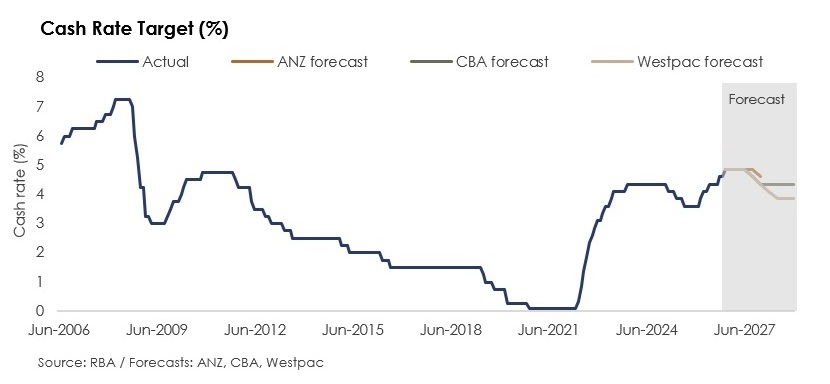
The Reserve Bank of Australia (RBA) raised the cash rate by 25 basis points to 4.85% in November 2026, its fifth increase this year and the highest level since late 2008. It also revised its inflation outlook upward and downgraded its growth forecasts, now expecting Gross Domestic Product (GDP) growth of just 1.3% in 2027. This puts the RBA in a difficult position: inflation remains too high, but the economy is clearly losing momentum. For Australia's property market, higher-for-longer interest rates will continue to weigh on buyer demand and sales activity. In Victoria, many buyers are waiting until after the state election, so subdued conditions are likely to persist in the near term.
Persistent inflation, slowing growth and the highest cash rate since 2008 create a more challenging outlook for Australia's property market
Can global growth outrun the uncertainty?
Global economic uncertainty remains elevated, with the conflict in the Middle East yet to reach a durable resolution. Brent crude peaked at around USD 116 a barrel in late October, before falling sharply after the US midterm elections, in which the Democrats won control of both the House and the Senate. Markets read the result as increasing pressure on the US administration to negotiate an end to the conflict, and Brent fell to around USD 94 a barrel, its lowest level in two months. However, the new Congress does not take office until January, and without a peace agreement, oil prices remain elevated and highly sensitive to any sign of progress or escalation. While global growth has so far proved more resilient than expected, supported by AI-related investment, uncertainty surrounding inflation, monetary policy and broader geopolitical tensions remains a downside risk to the outlook for 2027.
Can the RBA get inflation under control?
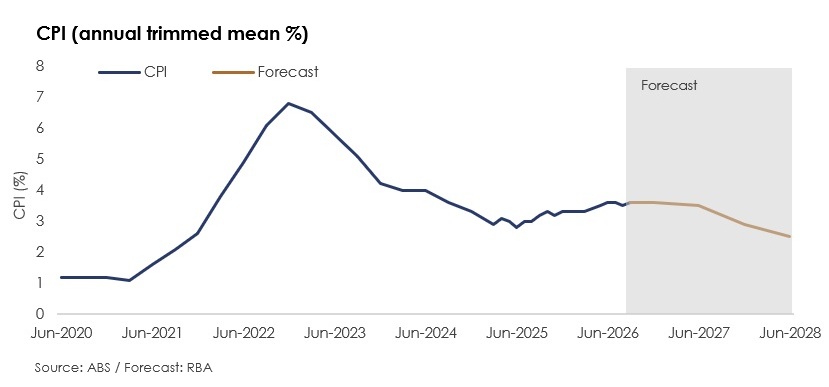
Elevated energy prices continue to delay disinflation globally. At its November 2026 meeting, the RBA increased the cash rate by 25 basis points to 4.85%, its fifth rise this year and its highest level since late 2008. The decision was by majority, with six members voting to raise rates and three to hold, and reflects an upward revision to the inflation outlook and a growing risk that higher inflation expectations become embedded. Headline Consumer Price Index (CPI) rose 4.3% over the 12 months to September, driven by a sharp rise in fuel prices, while underlying (trimmed mean) inflation was 3.6%. The RBA now expects both measures to remain above 3% until end-2027, returning to the midpoint of the 2–3% target band only in mid-2028. The Board said it will remain attentive to the data and do what it considers necessary to return inflation to target, while acknowledging uncertainty around the economic effects of the housing market downturn.
Is Australia’s jobs market losing steam?
Australia's labour market continues to ease gradually, with the unemployment rate rising to 4.7% (seasonally adjusted) in September, its highest level since late 2021. Employment fell by around 27,000 over the last three months and the participation rate eased slightly to 66.8%. Wage growth moderated to 3.2% p.a. in the June quarter 2026, down from 3.3% in March, and remains below headline inflation, implying continued declines in real wages. Looking ahead, the RBA's November Statement on Monetary Policy forecasts unemployment to rise further to reach 4.9% by end-2027 and 5.1% by end-2028. However, the RBA now judges capacity pressures in the economy, including in the labour market, to be a little tighter than previously estimated, which risks prolonging inflationary pressure even as unemployment rises.
Will economic growth continue to slow?
GDP grew 0.4% in the June quarter 2026 and 2.1% over the 12 months, reflecting a slowdown from the stronger pace recorded over the second half of 2025. Private sector activity remained the key driver, supported by robust business investment, particularly data centre and renewables construction, although investment remains soft outside of these areas. Household consumption also made a positive contribution, rising 0.4% over the quarter and 1.8% over the year, driven by discretionary spending, notably vehicle purchases. However, at a per capita level, real household consumption has stalled since its post-COVID recovery, with total consumption growth only marginally outpacing population growth of around 5% over the last four years. This stagnation reflects the combined impact of cost-of-living pressures, high and rising interest rates and cautious consumer sentiment, and points to a softer outlook for economic growth.
“The increased demand for construction materials coupled with a competitive labour market is impacting the viability of proposed developments. Whilst the built-form sector is the most heavily impacted via material cost increases, the effects are also evident in the residential subdivision sector, primarily with materials delays impacting delivery time frames.” - Andrew Binney, National Director | Residential Development Valuations (QLD), Charter Keck Cramer
What do current economic conditions mean for Australia's property market?
The RBA’s November forecasts suggest GDP growth in Australia will slow to 1.3% in 2027 and 1.5% in 2028. This reflects a downgrade in the forecasts from three months ago. We note the following risks to the outlook: globally, the risk that geopolitical disruption and elevated oil prices weigh further on global growth and inflation, and the ongoing impact of US trade tariffs; and domestically, the risk that rising interest rates, weak consumer sentiment and the ongoing housing market downturn further constrain household spending. Higher-for-longer interest rates and slowing economic growth will continue to weigh on buyer demand, keeping sales activity subdued. In the short term, there are no clear indicators of a shift in market conditions, especially in Victoria where market participants are deferring decisions until after the state election. As a result, current conditions are likely to persist for the time being.
“Buyers remain selective across Melbourne’s residential market, with realistic pricing important to achieving a sale. Higher borrowing costs continue to constrain purchasing capacity, although their influence varies across price brackets. In the prestige market, equity-backed purchasers are less directly affected by lending constraints, but remain sensitive to value, location and property quality. The upper end remains thinly traded, and vendors’ expectations need to reflect current market conditions.” - Victoria Peavey, Director | Prestige Residential & Residential Development Valuations (VIC), Charter Keck Cramer
Key takeaways for Australia’s property market
- Higher rates are squeezing buyers. The RBA lifted the cash rate to 4.85% in November 2026, its fifth increase this year. This is reducing borrowing capacity and weighing on buyer demand across the residential property market.
- Relief for Australia's property markets is unlikely before 2028. The RBA doesn’t expect inflation to return to the midpoint of its 2–3% target band until mid-2028. This means higher-for-longer interest rates will continue to constrain buyers and investors through 2027.
- Victorian buyers are waiting it out. Sales activity has slowed, and in Victoria this is being exacerbated as many buyers are delaying decisions until after the state election. Consequently, subdued conditions are likely to persist in the near term.
Frequently asked questions
- Why did the RBA increase interest rates in November 2026? The RBA raised the cash rate by 25 basis points to 4.85% in its fight against inflation, which is proving more persistent than expected. Headline inflation reached 4.3% in the year to September, driven by higher fuel prices, while underlying inflation was 3.6%. The RBA also revised its inflation outlook upward and warned of a growing risk that higher inflation expectations could become entrenched.
- What is the outlook for Australian interest rates and inflation in 2027? The RBA expects both headline and underlying inflation to remain above 3% until the end of 2027, returning to the midpoint of its 2–3% target band only in mid-2028. As a result, interest rates are likely to remain elevated through 2027. The RBA has said it will do what it considers necessary to bring inflation back to target, leaving the door open to further rate rises.
- How could slowing economic growth affect Australia’s property market? Slowing growth, rising unemployment and falling real wages are reducing household confidence and borrowing capacity, and this is weighing on buyer demand. Combined with higher-for-longer interest rates, this is likely to keep sales activity subdued across Australia’s residential property market. In Victoria, uncertainty ahead of the state election is adding to the slowdown, with many buyers delaying decisions.
Sources: Charter Keck Cramer, Reserve Bank of Australia (RBA), Australian Bureau of Statistics (ABS) and other relevant data providers.
Author: Charlotte Tolfree, Consultant | Research, Charter Keck Cramer