

2 December 2025
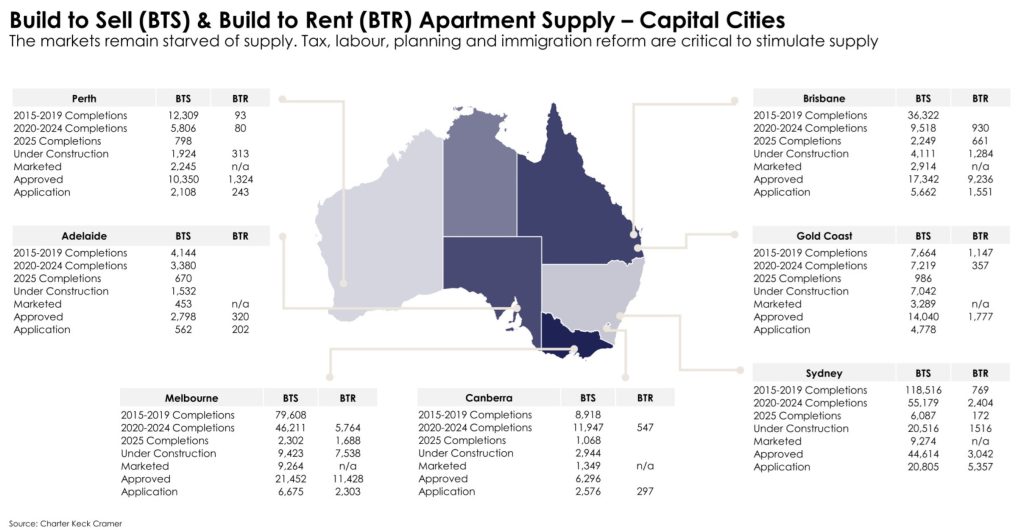
Australia’s capital cities have grown by around 1.2 million people in each five-year period since 2015, yet housing supply Australia-wide has not kept pace, falling from 269,500 completions between 2015–2019 to just 149,300 between 2020–2024. While population growth from 2025–2029 is expected to remain similarly strong, even the notional pipeline of 300,700 apartments - assuming every project proceeds - will still leave most markets chronically undersupplied. Charter Keck Cramer stresses that without coordinated, meaningful reform across tax, labour, planning and immigration settings, Australia will continue to miss Federal and State housing targets. However, if governments act decisively, the private sector is ready to respond and help address the long-term housing crisis.
Between 2015 to 2019 the population of Australia’s capital cities increased by 1,198,400 people. During this period there were 269,500 apartments delivered.
Over 2020 to 2024 the population of Australia’s capital cities increased by 1,196,200 people. And during this period there were 149,300 apartments delivered.
Projected Demand vs. Expected Apartment Delivery
Based on the current government projections, over 2025 to 2029 the population of Australia’s capital cities is forecast to increase by 1,169,200 people. Based on Charter Keck Cramer’s forecasts, and assuming all projects are able to achieve presales and receive funding and then get built, there are estimated to be 300,700 apartments notionally to be delivered.
The Need for Coordinated Policy Reform
Most markets are chronically starved of new supply. It is absolutely critical that the Federal, State and Local governments come together and enact meaningful tax, labour, (further) planning and immigration reform. Until this occurs, supply at scale is not going to be able to be mobilised, which means Australia will substantially undershoot the various Federal and State housing targets. Conversely, should governments come together, make decisions that transcend political affiliations and enact meaningful reform it is evident that the private market is ready and waiting to respond to this generational challenge.
Charter Keck Cramer urges policy makers to make the correct long-term decisions to address the housing supply Australia crisis which is a long-term problem.